250.52 Grounding Electrodes Electrodes Permitted for Grounding.

  • Post author:
  • Post category:News

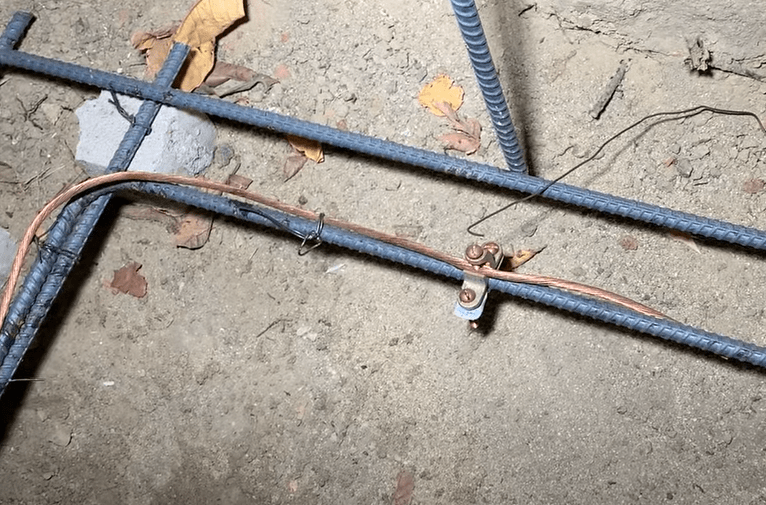
This weeks news letter is about what we call a Uffer Ground (Concrete encased electrode) 250.52(A)(3).  It seems to be a mis-interpreted Code section, that a lot of contractors and inspectors alike do not understand.  This Uffer Ground is a type of grounding electrode and not a point to bond the steel in a building slab. We are not bonding the steel in a slab of a building, we making the steel in the slab of a building into a grounding electrode, one 20’ piece.

As stated in the Code section we are to take 20’ of rebar and run #4 cu.to it and use it as one of our required grounding electrodes, when it is available.  Yes, if it is available.  If we missed it on the pour of the slab it then becomes unavailable, so we use some other method.  If you miss it and it is called for on the plan you will need to get the plans changed to show another method. It is not required to chip into the slab and expose a piece of steel so that we can accomplish this, because how do we know it is 20’ long.

So if your slab has several separated steel electrodes (ones that are 20’ and are available) you don’t have to bond them all together to form one, we just need one. (see the highlighted section below)  Then next time you fail an inspection for not boding all the steel pads in a home, remember “YOU DON”T HAVE TO”!!!

One other note on this electrode is the informational note at the bottom of the section which states that the concrete should be in direct contact with the earth and not sitting above a piece of plastic vapor barrier.  

250.52(A)(3) Concrete-Encased Electrode. A concrete-encased electrode
shall consist of at least 6.0 m (20 ft) of either (1) or (2):
(1) One or more bare or zinc galvanized or other electrically
conductive coated steel reinforcing bars or rods of not less
than 13 mm (1⁄2 in.) in diameter, installed in one continuous
6.0 m (20 ft) length, or if in multiple pieces connected
together by the usual steel tie wires, exothermic welding,
welding, or other effective means to create a 6.0 m (20 ft)
or greater length; or
(2) Bare copper conductor not smaller than 4 AWG

Metallic components shall be encased by at east 50 mm
(2 in.) of concrete and shall be located horizontally within that
portion of a concrete foundation or footing that is in direct contact
with the earth or within vertical foundations or structural
components or members that are in direct contact with the earth.
If multiple concrete-encased electrodes are present at a building
or structure, it shall be permissible to bond only one into the
grounding electrode system.

  
Informational Note: Concrete installed with insulation, vapor
barriers, films or similar items separating the concrete from the
earth is not considered to be in “direct contact” with the earth.

Uffer Ground

Next we have a new type of connector in a meter can given to me by Howard of Stuart.

meter base

Till next time be safe work safe.

Jake


Continue Reading250.52 Grounding Electrodes Electrodes Permitted for Grounding.

680.14 Corrosive Environments around pools 2017 Code Change

This new section gives us the requirements for wiring methods when you have stored chemicals in the same area as your pool equipment.  Most of the chemicals that are used in pool maintenance are corrosive and the vapors can end up in the air and cause damage to the electrical system for the pool.  When I use to do pools we always kept most of the electrical work above 48” so that we were above some of the vapors.  A good installation will have a ventilation system to take these vapors out of the room.

Screenshot 2021-12-30 121937

For those of you who missed our continuing education class in December don’t fret we will be running a few more next year in time for the renewal of your license.

Till next year be safe work safe

Jake

Continue Reading680.14 Corrosive Environments around pools 2017 Code Change

ARTICLE 555 — MARINAS, BOATYARDS, AND COMMERCIAL AND NONCOMMERCIAL DOCKING FACILITIES 555.24 SIGNAGE

A new section has been added to article 555 requiring signs to be placed so as to “WARN” people of the protentional hazards that could exist in the water. If you are working on a marina or dock you will be required to post “permanent signs” to warn potential swimmers of the hazard that could be there.

image

Till the next time be safe work safe.

Jake

Continue ReadingARTICLE 555 — MARINAS, BOATYARDS, AND COMMERCIAL AND NONCOMMERCIAL DOCKING FACILITIES 555.24 SIGNAGE

555.3 Ground fault protection Code Change 2017 NEC

This section has changed the GFCI protection for marinas and docks from a 100 mA down to 30 mA.  When a marina’s or dock’s electrical system is installed, it must be installed under the adopted code at time of installation.  So an existing dock will not be required to updated unless a major upgrade or expansion to the dock is made.  You may still run into the AHJ that will require you to change the feeder or branch circuit device on an existing dock, but that was not the intent of this “new change”.  This covers both residential and commercial marinas and docks.

image

On another note we have set the dates for our first in class CEU courses.  December 7th and 8th will be our first 7 hours of continuing education for the new cycle.  Hope to see you there.

Till next time be safe work safe.

Jake

Continue Reading555.3 Ground fault protection Code Change 2017 NEC

New addition to article 555 Code change 2017 NEC

This weeks change has been one that was long over due.  They finally added residential docks and marinas to the code for us to follow and enforce.  As an inspector I used to argue with contractors over residential docking facilities about what does and doesn’t apply.  Well the argument is over.  Residential docks and marinas are now listed in the scope of Article 555.  So for this weeks change that’s where we will stop.  We now have Codes that will protect people who are using residential docking facilities, where in the past it was always an argument and the use of 90.4 to enforce something that should have been in the Code book years ago.  Article 555 now includes residential docks!

image

In the next newsletter we will look into the sections of 555 and try and clear up some of the new requirements.

For those of you wondering if we are ever going to do continuing education again, we are planning to do a two-night seminar in December.  Watch for our email.

Till the next time work safe be safe

Jake

Continue ReadingNew addition to article 555 Code change 2017 NEC

422.5 Ground-Fault Circuit-Interrupter (GFCI) Protection for Personnel 2017 Code Change (Clarification)

This weeks Code change is really just a clarification of voltages requiring GFCI protection, 250V or less and 60 amperes or less on single and three phase systems.  It also clarifies what type of GFCI protection can be provided upstream from the equipment in (B).

image

Also included this week is another great picture from out there somewhere.

FPE NB

Don’t have a knockout set just cut the bottom out and run a bonding jumper.

Till next time be safe work safe

Jake

Can’t see the whole picture just click on them.

Continue Reading422.5 Ground-Fault Circuit-Interrupter (GFCI) Protection for Personnel 2017 Code Change (Clarification)

Renewing your Palm Beach County License

  • Post author:
  • Post category:News

I have had several calls from contractors looking for Continuing Education classes.  If you have a Palm Beach County license and are renewing your PBC license send them your CEU’s from last two years (2019 and 2020) that you got for the state renewal last year.  The State of Florida does not have a renewal this year its next year 2022.  We will be back in class giving CEU classes this December.  If you renew with the State next year you are ONLY REQUIRED to get 11 hours if you have an EC or ER license, and 7 hours for all other specialty licenses for the State.  One of the problems with this new requirement is the State only wants 11 or 7 hours, but Palm beach County still wants 14 hours.  So in order to renew in PBC you will have to get extra hours not required by the State.

So starting in December we will be offering the 11 hrs. required by the State plus the other 3 required by Palm Beach County if you need them. 

Below is the list of “STATE” required hours for our trade as of July 1, 2020.

Effective July 1, 2020 a licensee must complete the following continuing education prior to renewal:

Certified Electrical Contractors (EC) = 11 hours of Continuing Education
1 hour workers’ compensation
1 hour workplace safety
1 hour business practices
1 hour Florida Laws & Rules
7 hours of Technical to include – 1 hour Florida Building Code advanced module course and 2 hours false alarm prevention for all certified electrical contractors who perform alarm work

Registered Electrical Contractors (ER) = 11 hours of Continuing Education
1 hour workers’ compensation
1 hour workplace safety
1 hour business practices
1 hour Florida Laws & Rules
7 hours of Technical to include – 1 hour Florida Building Code advanced module course

Certified and Registered Alarm Contractors = 7 hours of Continuing Education
1 hour workers’ compensation
1 hour workplace safety
1 hour business practices
1 hour Florida Laws & Rules
2 hours false alarm prevention
1 hours of Technical to include – 1 hour Florida Building Code advanced module course

Certified and Registered Specialty Contractors = 7 hours of Continuing Education
1 hour workers’ compensation
1 hour workplace safety
1 hour business practices
1 hour Florida Laws & Rules
1 hours of Technical to include – 1 hour Florida Building Code advanced module course
2 hours general credit

Confused by all this email me (jlecceamil@hotmail.com) or Text me at (561-596-7347) I will try to help you if needed.

Till next time be safe work safe.

Jake
Continue ReadingRenewing your Palm Beach County License