Single Phase dwelling services

It’s back, after a few years they finally brought this table back into the Code.  For the last few cycles it has been found in the examples back in Annex D.  It’s been a few years but it’s back  The 83% still lives on, but they also gave us 31012 TABLE, which shows us what size conductors we can use for a dwelling service.  Remember this TABLE only works when we feed the entire load from one feeder/service (see A through D below).  If you have two mains then this table does not work and you have to go to 310.16 for the conductors.

image

A through D below applies to 120/240 single phase services, and A through C applies to 120/208Y services.

(A) Services.  For a service rated 100 amperes through 400 amperes, the service conductors supplying the entire load associated with a one-family dwelling, or the service conductors supplying the entire load associated with an individual dwelling unit in a two-family or multifamily dwelling, shall be permitted to have an ampacity not less than 83 percent of the service rating. If no adjustment or correction factors are required, Table 310.12 shall be permitted to be applied.

(B) Feeders.  For a feeder rated 100 amperes through 400 amperes, the feeder conductors supplying the entire load associated with a one-family dwelling, or the feeder conductors supplying the entire load associated with an individual dwelling unit in a two-family or multifamily dwelling, shall be permitted to have an ampacity not less than 83 percent of the feeder rating. If no adjustment or correction factors are required, Table 310.12 shall be permitted to be applied.

(C) Feeder Ampacities.  In no case shall a feeder for an individual dwelling unit be required to have an ampacity greater than that specified in 310.12(A) or (B).

(D) Grounded Conductors.  Grounded conductors shall be permitted to be sized smaller than the ungrounded conductors, if the requirements of 220.61 and 230.42 for service conductors or the requirements of 215.2 and 220.61 for feeder conductors are met.

Where correction or adjustment factors are required by 310.15(B) or (C), they shall be permitted to be applied to the ampacity associated with the temperature rating of the conductor.

Informational Note No. 1:

The service or feeder ratings addressed by this section are based on the standard ampere ratings for fuses and inverse time circuit breakers from 240.6(A).

image

Till next time be safe work safe.

Jake
Continue ReadingSingle Phase dwelling services

2020 NEC goes into effect

Just wanted to wish you all a Happy New Year, and remind you that the 2020 NEC is now in effect.  All permits pulled prior to 12/31/23 are still going to use the 2017 NEC.

NEW TO THE 2020 NEC IS ARTICLE 242 WHICH COMBINES OLD ARTICLES 280 AND 285.  THIS ARTICLE SHOULD MAE IT EASIER TO UNDERSTAND THE REQUIREMENTS FOR SURGER ARRESTERS AND SURGE-PROTECTIVE DEVICES.

242

Till next time be safe work safe

Jake

Continue Reading2020 NEC goes into effect

230.71 Maximum Number of Disconnects, (B) Two to Six Service Disconnecting Means

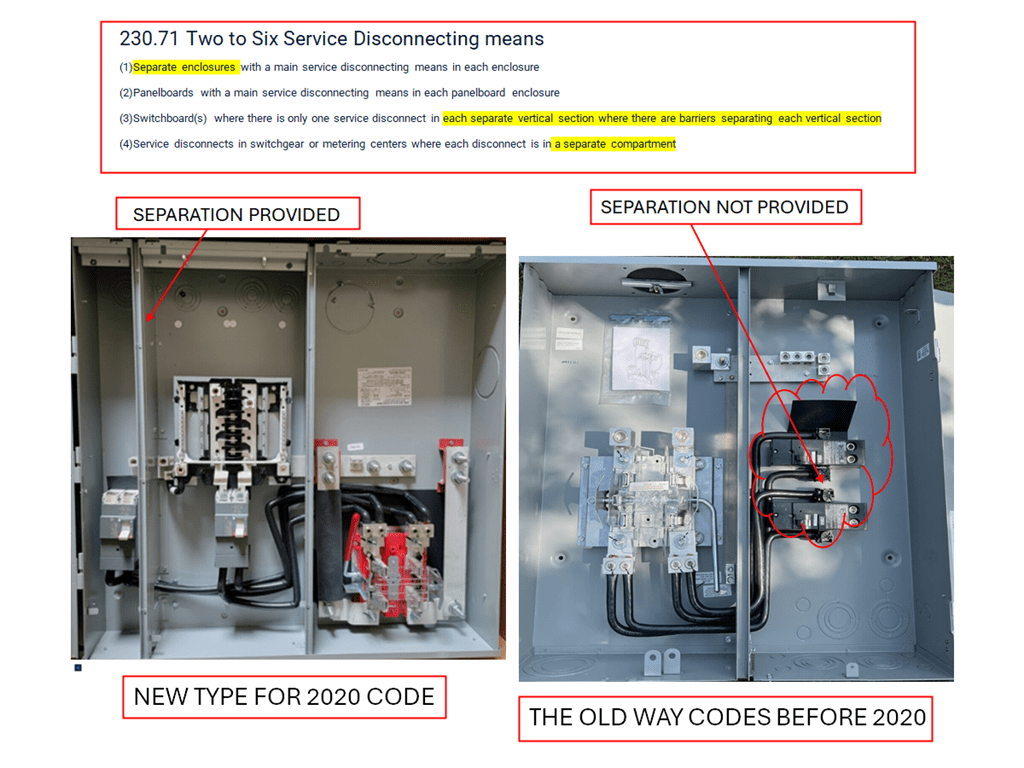
The six service disconnect rule for services is retained in the 2020 edition of the NEC, but is revised with the change that for up to six service disconnects they would require each disconnecting means to be installed in separate enclosures or separate compartments.  We will no longer will be able to have a meter main combo with two 200 amperes mains fed off of a 400 ampere meter if they enclosed in a single enclosure.  See the changed Code section below.  

The mains below in the picture are enclosed in separate enclosures within the piece of switchgear.

image

230.71(B) Two to Six Service Disconnecting Means.

Two to six service disconnects shall be permitted for each service permitted by 230.2 or for each set of service-entrance conductors permitted by 230.40, Exception No. 1, 3, 4, or 5. The two to six service disconnecting means shall be permitted to consist of a combination of any of the following:

(1) Separate enclosures with a main service disconnecting means in each enclosure

(2) Panelboards with a main service disconnecting means in each panelboard enclosure

(3) Switchboard(s) where there is only one service disconnect in each separate vertical section where there are barriers separating each vertical section

(4) Service disconnects in switchgear or metering centers where each disconnect is located in a separate compartment

Informational Note No. 1:  Metering centers are addressed in UL 67, Standard for Panelboards.

Informational Note No. 2:  Examples of separate enclosures with a main service disconnecting means in each enclosure include but are not limited to motor control centers, fused disconnects, circuit breaker enclosures, and transfer switches that are suitable for use as service equipment.

Till next time be safe work safe

Jake


Continue Reading230.71 Maximum Number of Disconnects, (B) Two to Six Service Disconnecting Means

Service Equipment BARRIERS 230.62(C)

A new section was added to service equipment for barriers.

230.62(C)  Barriers.

Barriers shall be placed in service equipment such that no uninsulated, ungrounded service busbar or service terminal is exposed to inadvertent contact by persons or maintenance equipment while servicing load terminations.

If disconnecting or de-energizing the service conductors supplying a service panelboard, switchboard, or switchgear is not feasible, it might be necessary for a qualified person to work on that equipment with the load terminals de-energized but with the service bus still energized. Barriers provide physical separation (adequate distance or an obstacle) between load terminals and the service busbars and terminals. This provides some measure of safety against inadvertent contact with line-energized parts during maintenance and installation of new feeders or branch circuits.image

Can’t see the whole picture just Click on it.

Till next time be safe work safe.

Jake

Text taken from the enhanced Code Book 2020 NFPA 70.

Continue ReadingService Equipment BARRIERS 230.62(C)

230.46 Spliced and Tapped Conductors (On the Service side)

New to the 2020 NEC is a section on “line side splices or taps”.  Devices used to make splices or taps on the line side of the service disconnect shall now be listed for use on the line side of the main (service side).  Section call for effective date of 1/1/23, but will not actually go into effect until 12/31/23 when adopted by the Florida Building Code.

Can’t see the whole picture just click on it.

image

Till next time be safe work safe.

Jake

Continue Reading230.46 Spliced and Tapped Conductors (On the Service side)

220.12 General Lighting Loads “NOT TO BE USED UNTIL 12/31/23”

New in the 2020 Code book is an adjusted  “General Lighting Load Table “ for most types of occupancies except for dwelling units.  The lighting loads have been changed to new “VALUES” based on how much lower the wattage is for new LED lighting being installed.  The table shown below is just a sample of the table and not the complete one.  The values are drastically reduced and include the 125% for continuous load factors.  Just as the Table states it covers all occupancies except dwelling units, dwelling units will be covered in section 220.14(J),  which is also new to the Code book.  You will find the the general lighting loads are a lot smaller now for non-dwelling load calculations which will reduce the size of the lighting loads to large buildings, which will lend help with other new loads that we are seeing such as car chargers.  There are several notes that go with the table to explain which lighting loads go with which type of occupancy.  In the table the far righthand column is the VA per square foot number that we will use figure the general lighting load.


image

Note: The 125 percent multiplier for a continuous load as specified in 210.20(A) is included when using the unit loads in this table for calculating the minimum lighting load for a specified occupancy.

a Armories and auditoriums are considered gymnasium-type occupancies.

b Lodge rooms are similar to hotels and motels.

c Industrial commercial loft buildings are considered manufacturing-type occupancies.

d Banks are office-type occupancies.

e Garages — commercial (storage) are considered parking garage occupancies.

f Clubs are considered restaurant occupancies.

g Barber shops and beauty parlors are considered retail occupancies.

h Stores are considered retail occupancies.

Till next time be safe work safe

Jake

Continue Reading220.12 General Lighting Loads “NOT TO BE USED UNTIL 12/31/23”

210.52(G)(1) Basement, Garages, and Accessory Buildings Exception. “DO NOT USE UNTIL 12.31.23”

This is a new exception to this required outlet in garages.  If you are wiring an apartment building that has separate garages for some of the units it is not required to have an outlet in that space.

image

Till next time, Be safe work safe

Jake

Continue Reading210.52(G)(1) Basement, Garages, and Accessory Buildings Exception. “DO NOT USE UNTIL 12.31.23”